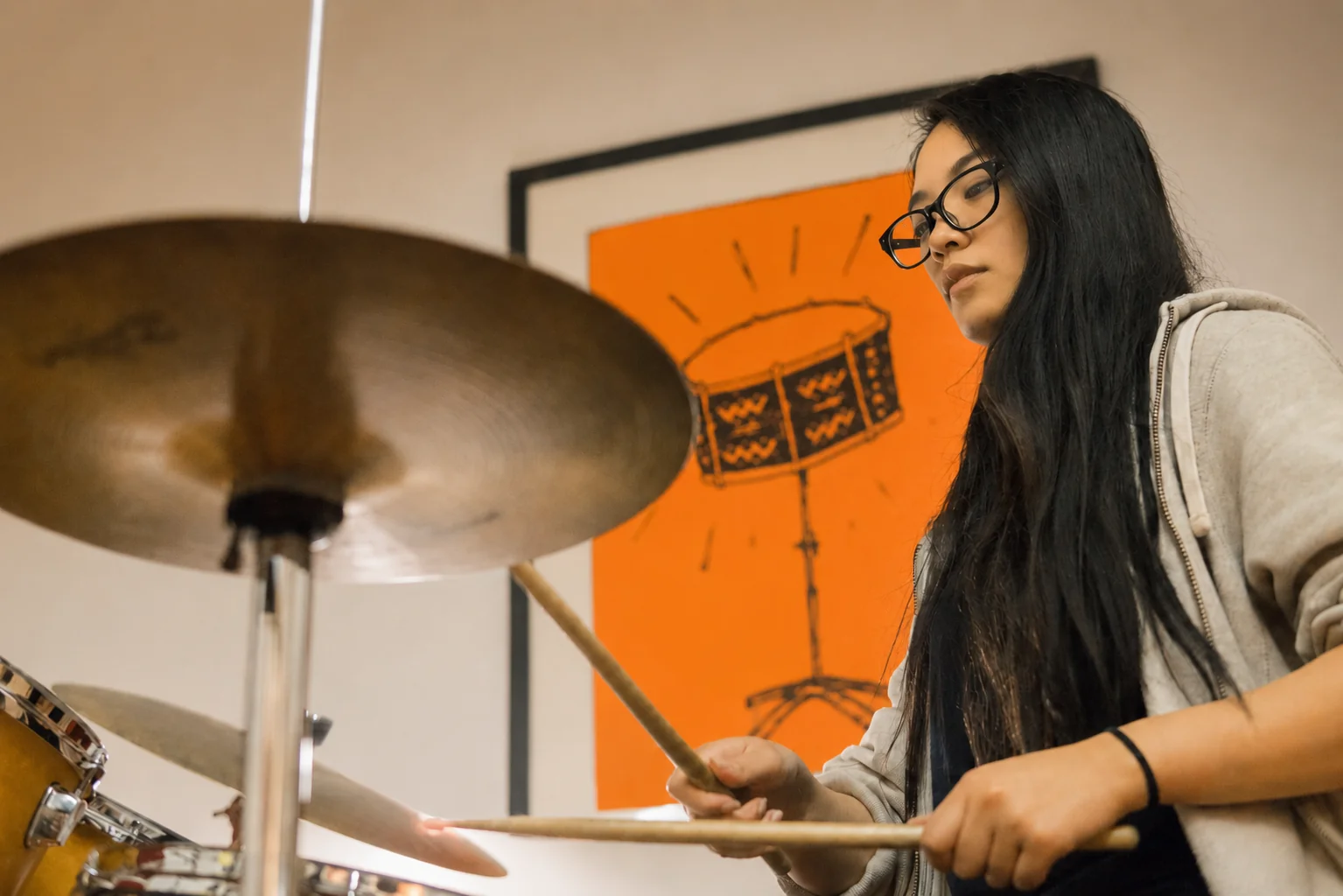
What to Expect in Your First Drum Lesson
If you're booking a first drum lesson, it's completely normal to feel a flutter of nerves alongside the excitement. Most people sit down at the kit for the first time wondering whether they'll look silly, whether they need to already know something, or whether they've left it too late. The honest answer to all three: don't worry. A good first lesson is built to put a complete beginner at ease, and to have you playing an actual beat before you leave.
Here's exactly what tends to happen, what to bring, and how quickly you'll start to feel like a drummer.
No experience needed, really
You don't need to read music, own a kit, or have ever held a pair of sticks to start. Whether you're a child tapping along to songs at home or an adult who's wanted to play for thirty years, beginner lessons start from the very beginning and build up step by step. A good teacher's whole job in lesson one is to make you comfortable, not to test you.
Getting to know the kit
Your teacher will start by walking you around the drum kit so it stops looking like an intimidating pile of metal and starts making sense. You'll learn the names and jobs of the main parts: the snare and bass drum (the heartbeat of the kit), the hi-hat, and the crash and ride cymbals, and how they work together. You'll also get set up properly, with the right stool height and a comfortable, natural playing position for your body.
Holding the sticks and sitting well
Next comes grip and posture. It sounds basic, but how you hold the sticks and carry your body is what lets you play for years without tension or injury. Your teacher will show you a relaxed grip, how to let the stick rebound rather than forcing it, and how to stay loose through the shoulders and wrists. Get these foundations right early and everything that follows is easier.
Playing your first beat
This is the part everyone remembers. Most first-timers play a recognisable groove in their very first lesson. Typically you'll count "1, 2, 3, 4" out loud, lay down a steady pulse on the hi-hat with one hand, add the snare on beats 2 and 4, then drop the bass drum on 1 and 3, and suddenly you're playing a real rock beat. The coordination feels strange for a few minutes, because your hands and feet have never been asked to work independently like this, then it clicks, and it's genuinely thrilling.
What to bring
Not much:
- A pair of drumsticks if you already have them. If you don't, no problem, we'll provide a pair for the lesson.
- A positive, curious attitude. Questions are welcome and mistakes are expected.
There's no need to bring a drum kit, and absolutely no pressure to buy equipment. Which leads neatly to the most common worry.
You don't need to buy a kit to start
It's tempting to rush out and buy a drum kit, but hold off. For the first few weeks, all you really need to practise at home is a pair of sticks and a practice pad, which is quiet, cheap, and brilliant for building hand technique and timing. When you're ready to invest, your teacher can recommend a kit that suits your budget and space. And if you live in a flat where a kit isn't an option, you can always use our practice rooms to play a full set without upsetting the neighbours.
How quickly will I progress?
Progress depends more on consistency than on long, punishing practice sessions. A realistic picture:
- Lesson one: a simple beat, basic stick control, and sitting comfortably at the kit.
- First few weeks: cleaner coordination and steadier timing, especially with regular short practice.
- A few months in: playing along to real songs and locking in with a metronome.
A common surprise for adult learners is that the hardest part isn't the physical side; it's patience. A seven-year-old plays a sloppy beat and laughs; an adult plays the same beat and frowns. A good teacher designs lessons where small wins are celebrated and mistakes are simply part of the process, which is exactly what keeps you coming back.
Your first drum lesson at Planet drum
We've been teaching beginner drum lessons in North London since 1997, from The Crypt at St Mary Magdalene Church in Holloway, about two minutes from Highbury & Islington station, so it's an easy trip from Islington, Highbury, Finsbury Park and across N1, N5 and N7. Lessons are one-to-one and tailored entirely to you, for children and adults alike, from total beginners to advanced players. As a Trinity Rock & Pop and Rockschool exam centre, we can also take you all the way to graded exams later on if that's a goal. But in lesson one, it's simply about getting comfortable and having fun, and the best way to settle any nerves is to come and try a taster lesson.
Frequently asked questions
Do I need my own drum kit or sticks for my first lesson? No. We can provide sticks and you'll play on our kit. Bring your own sticks if you have them, but there's no need to buy anything to begin.
Will I actually play something in the first lesson? Almost certainly. Most beginners play a simple groove within their first session, which is one of the best parts of starting drums.
Is a first drum lesson suitable for young children? Yes. We teach children and adults, and lessons are pitched to each student's age and level so everyone starts comfortably.
How often should I practise? Short and regular beats long and occasional. Even 10 to 15 minutes on a practice pad most days will move you forward faster than one long weekend session.